

What changes
Both views, while you migrate
Flaky Tests opens on your test collections. To reach the repository view, click Legacy view on the collections list; to come back, click Test collections on the repository overview. Trunk remembers whichever you chose and opens there next time.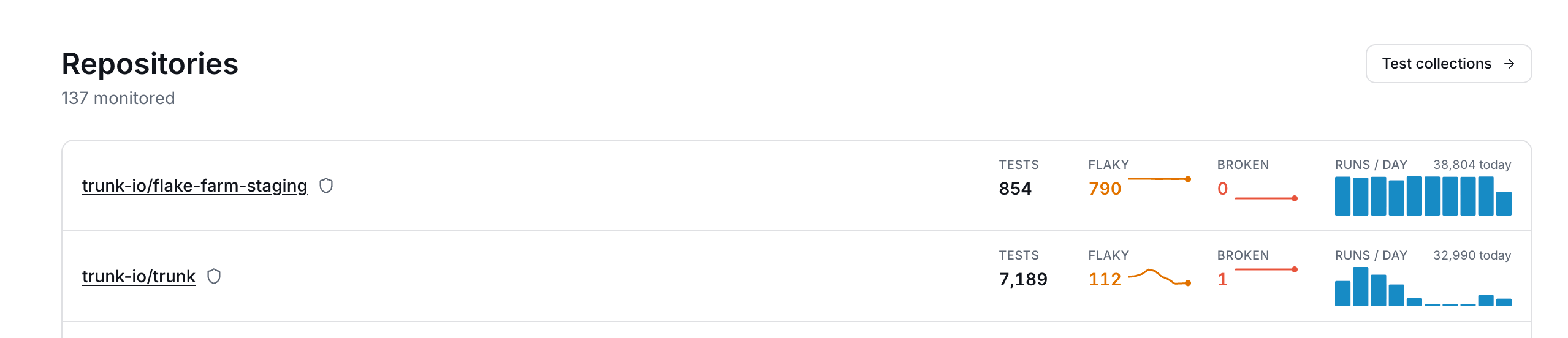
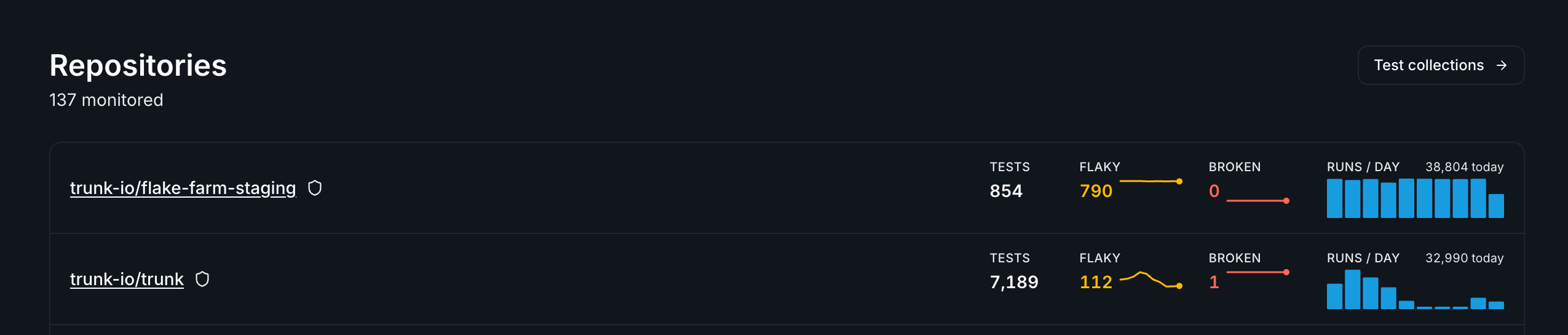
From the repository view, Test collections crosses over.
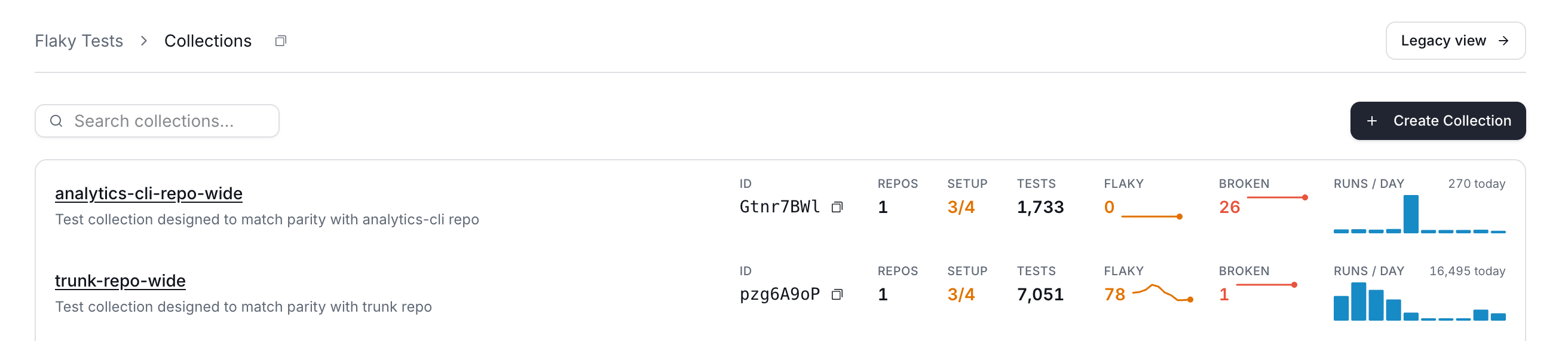
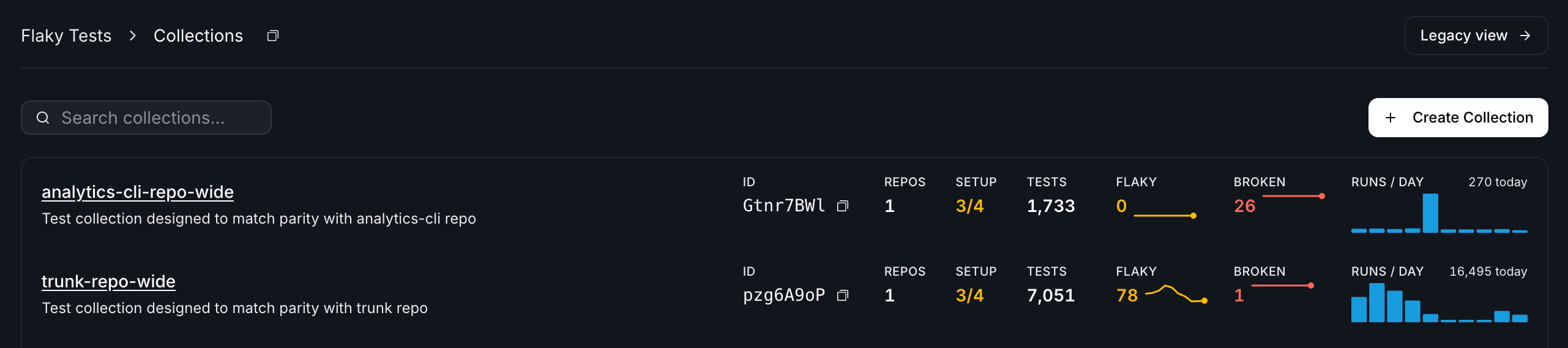
From the collections view, Legacy view crosses back.
Nothing carries over from your repositories
Monitors, quarantine overrides, ticketing configuration, and infrastructure-failure thresholds are all per-collection. A repository’s configuration does not transfer to a collection, so anything you have tuned on a repository has to be set up again on the collection you want it on. That is often what you want. You may wish to create different monitors for each collection, such as more sensitive flakiness detection for unit tests than for end-to-end tests.Migrate a CI job
1
Create a collection
Collections usually map to a team, a service, or a test suite. Group tests you want to configure and review together.See Create a collection.
2
Add the collection ID to one CI job
Add
--test-collection-id <COLLECTION_ID> to the job’s existing upload step, alongside the --org-url-slug it already passes. Start with one job rather than all of them.3
Confirm the results arrived
Open the collection’s Uploads tab. An upload appears as soon as Trunk accepts it, and fills in once the results are processed — so a bundle that contained no test results visibly stops at the first stage. The collection’s Tests tab unlocks once test cases have been ingested.
4
Review the collection's monitors
Open the collection’s Monitors tab and check the seeded defaults against what you run on the repository today. Adjust thresholds and branch patterns here rather than assuming the repository’s carried over.
5
Turn on quarantining, then re-apply your overrides
Quarantining is configured per collection, and enabling it replaces the repository’s quarantining for every upload routed to that collection. Your repository’s Always Quarantine and Never Quarantine overrides do not follow.Overrides can only be set once quarantining is enabled on the collection, so re-apply the ones that matter as soon as you turn it on.
6
Repeat, job by job
Move the rest of your CI jobs when you’re ready. Uploads without a collection ID keep going to the repository view, so a partly-migrated organization is a normal state to sit in.
Links in CI output
Once a job passes a collection ID, the links the CLI prints at the end of a run point at the collection. To keep the repository links while your team is still moving over, pass--hide-test-collection-links or set TRUNK_HIDE_TEST_COLLECTION_LINKS.
Running both views at once
While a repository and a collection both have monitors covering the same tests, they detect independently. That’s the point — it’s how you compare the two before committing — but it means:- A test can be flagged in both views, at different times, according to each one’s thresholds.
- If you use webhooks, one detection can produce two events — see below.
Webhooks while you migrate
Collection webhook events are off by default while you are migrating, and you switch them on from your organization’s webhooks settings once your consumers are ready. The control appears only while you have both views, since that is the only time it changes anything — once you have fully migrated, collection events are simply sent. It is one switch for every collection event, not one per event type. What you are asserting by turning it on is that your consumer handles collection payloads at all:- A collection event carries a
test_collectionobject. Repository events don’t, and that is the only supported way to tell the two apart. - You cannot deduplicate on
test_case.id. Collection and repository events don’t share a test-case ID space, so the same underlying test arrives under two unrelated IDs.repository.idis the only handle common to both. repositoryis omitted rather than guessed when an upload carries no repository.
Dashboards start fresh
Collections don’t backfill. A collection’s metrics begin at its first upload, so a correctly configured collection can still look empty for a day, and comparisons against a repository’s history aren’t meaningful until the collection has accumulated its own. Your repository history stays where it is and isn’t affected by migrating.Frequently asked questions
Why is my collection dashboard empty?
Why is my collection dashboard empty?
Collections don’t backfill history — metrics start at the collection’s first upload. If uploads are arriving and the dashboard is still empty, check the Uploads tab to confirm the results were processed and not just accepted.
Why aren't tests being quarantined?
Why aren't tests being quarantined?
Quarantining has to be enabled on the collection, and a test has to have been detected by one of the collection’s monitors. Check both on the collection’s Settings tab and Monitors tab.
Can a collection contain tests from several repositories?
Can a collection contain tests from several repositories?
Yes. Collections and repositories are many-to-many. A repository is part of a test’s identity, but that test can be uploaded separately to multiple collections.